Organizational Assessment
Understand what really works in your organization—not just what’s intended.
Allows leaders to act intentionally, leveraging influence where it truly exists

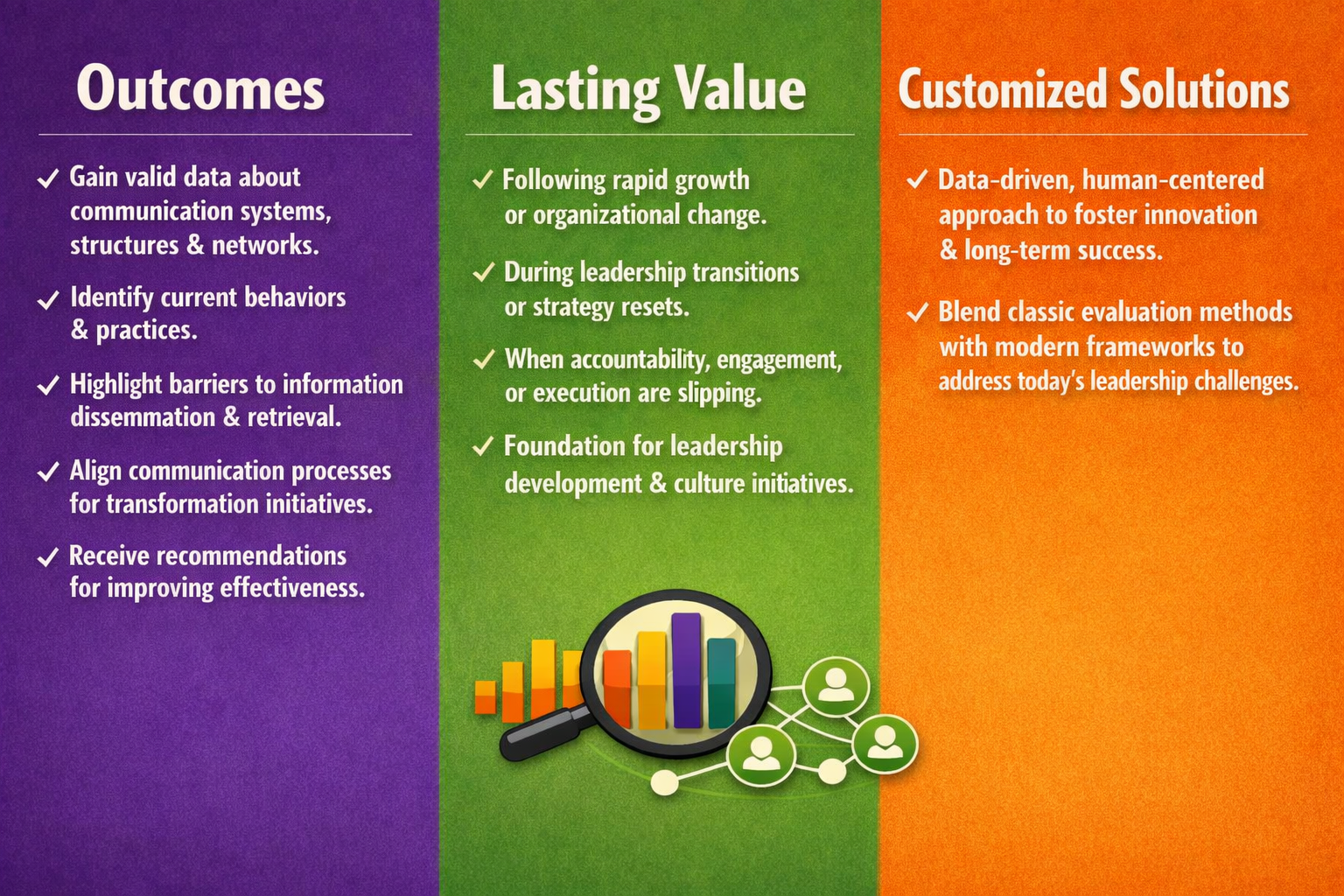
Our Assessments and Diagnostics help leaders see how information, decisions, perceptions and influence flow across the enterprise.
Our assessments surface systemic patterns that shape alignment, accountability, engagement and execution.
We use a multi‑method approach that combines quantitative data with qualitative insight to create a clear picture of your organization’s ecosystem.
We incoporate our Strategic Listening Architecture™ throughout Organizational Assessments. This deliberately planned approach engages with and gains insight from employees, equipping organizations with quantitative and qualitative strategies that lead to greater inclusion and retention success at individual, team and systems levels.
As an industry leader in listening assessment at the individual, team and system level, see our time-tested methods below:
Diagnostic Methods
We tailor each assessment using a mix of the tools below, based on your context, size and goals.

Our in-depth interviews go beyond the surface level of known issues to gain new insights. Using appreciative inquiry, our one-to-one interviews uncover:
- Leadership intent versus employee experience
- Decision‑making and escalation norms
- Assumptions about accountability, ownership and follow‑through
- Alignment and/or misalignment across the leadership system

Our turnkey survey hosting, survey design, administration of the confidential survey, analysis and recommendations provide a seamless process. We offer a quantitative and qualitative baseline:
- Strategic clarity and alignment
- Trust in leadership
- Stakeholder engagement – authentic voices, feedback and communication
- Accountability and decision clarity

Our expert facilitators create a safe, accepting space for confidential conversations to explore real experiences to help explain WHY survey patterns exist. Explore:
- Behavioral signals for “what really matters” in the organization
- Build confidence that input is valued, and individuals are “seen and heard”
- Shared narratives that rarely appear in survey data alone
- Ensured understanding for meaningful impact on change going forward
- Clarification on how messages are interpreted in day‑to‑day work

Reveal how work and communication actually flow beyond organizational charts.
Help identify:
- How information flows (channels, frequency, clarity and consistency)
- Where communication aligns with strategy and where it breaks down
- Accountability and ownership across functions and levels
- Places where leader visibility, credibility, trust and collaboration are strong
- Informal influencers and information brokers
- Bottlenecks, silos and overload points
- Where employees seek advice, support and approval
Workplace Effectiveness & Collaboration Blogs

Building an Effective Workplace from the OutsideIN
Most organizations work diligently to recruit a diverse workforce, with a range of ages, abilities, ethnicities, religions and worldviews. Identifying and hiring talent with such diverse backgrounds and characteristics is an accomplishment. Once hired, you can check off that Diversity & Inclusion box, right? Not so fast! Having a diverse workforce is only half of […]

How to Make Sure Others Use Their Voices to Get Heard
Strong voices for change are needed within organizations. A recent study suggests that only 29% of employees think that management listens to concerns about discrimination (race, sex/gender, age, etc.) without blame or defensiveness (Leadership IQ Survey). The question remains, what actions are these same organizations taking internally to ensure minority representation, equal hiring and promotion opportunities? As […]

Leaders, What Will You Do to Make a Difference?
Each weekday, NBC’s nightly news includes a final “Inspiring America” story. These stories showcase people who make a difference in the lives of others. They remind us that small actions can have a large impact to better our world. Consider, Jadav Payeng, “The Forest Man of India.” Saddened by how erosion and the changing ecosystem had destroyed the river island he loved, he began to plant one tree sapling each day on this decimated Island. Now, after almost 40 years, the trees he planted have reclaimed more than 1300 acres and become an Island with lush forests and abundant wildlife.
Our Services
Growing
Teams
Learn More:
Growing
Organizations
Keynote Presentations &
Webinars